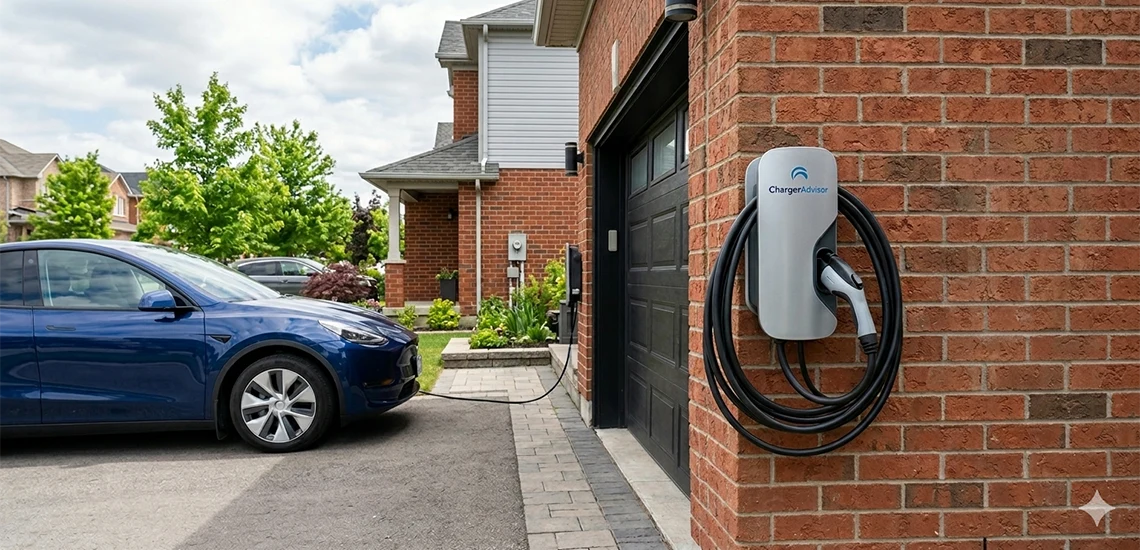
Key Takeaways
- Installing a Level 2 home EV charger is one of the highest-return electrical upgrades a Canadian homeowner can make in 2026, both in daily convenience and long-term property value.
- A licensed electrician is not optional — it’s required by law in most provinces for EV charger installation, and ESA (Electrical Safety Authority) approval is mandatory in Ontario.
- Your home’s electrical panel may need an upgrade before installation can happen; older panels rated at 100 amps or less are commonly insufficient.
- Government rebates and incentives are still available across Canada in 2026, which can meaningfully offset the upfront cost.
- Choosing the right charger and the right location inside or outside your garage matters more than most homeowners realize — and the decisions you make now affect how well the setup serves you for the next decade.
Electric vehicles are no longer a novelty. They’re parked in driveways across Canada in record numbers, and that trend is only accelerating. But here’s something a lot of new EV owners don’t think about until the second or third night of plugging into a standard household outlet: a 120-volt Level 1 charger is painfully slow. We’re talking 40 to 50 hours to charge some vehicles from empty. For a country where long winters drain batteries faster and people drive significant distances, that simply doesn’t cut it.
The solution is a dedicated home EV charger — what the industry calls a Level 2 charger — and getting one installed properly is a more nuanced project than it might appear on the surface. It’s not just an electrician drilling a hole and plugging something in. It involves panel assessments, permit applications, ESA inspections, hardware selection, and smart decisions about placement and future-proofing. Done right, it transforms your garage or driveway into a convenient charging hub. Done wrong, it creates safety hazards, permit headaches, and costs you more money to fix later.
This article walks you through everything you need to know — from how Level 2 charging actually works, to what the installation process involves, to what it means for your home’s value.
What Is a Level 2 EV Charger and Why Does It Matter
Level 2 chargers operate on 240 volts — the same voltage as your dryer or electric stove — and can typically add anywhere from 25 to 50 kilometres of range per hour of charging, depending on the vehicle and the charger’s amperage. For most Canadians, that means a full charge overnight, every night, effortlessly.
Compared to a Level 1 charger that comes in the box with many EVs, Level 2 is faster by a factor of 5 to 10. For anyone who drives more than 50 kilometres a day — which covers a large slice of suburban commuters, tradespeople, and families running kids to activities — Level 2 isn’t a luxury. It’s the only practical option for home charging.
Most residential Level 2 chargers are installed as hardwired units operating at 32 or 40 amps on a dedicated 240-volt circuit, though plug-in versions (which use a NEMA 14-50 outlet) are also an option for renters or those who want more flexibility. The hardwired approach is generally preferred for permanent homes because it’s cleaner, more reliable, and typically eligible for more rebate programs.
The Electrical Reality: Your Panel Comes First
Before any charger gets mounted on your wall, the first stop is your electrical panel. This is where many homeowners are surprised.
A 40-amp EV charger circuit requires a 50-amp breaker, and if your panel is already well-loaded with a modern kitchen, HVAC system, electric water heater, and other loads, finding that capacity isn’t always straightforward. If your home has an older 100-amp panel — common in homes built before the 1990s — there’s a reasonable chance you’ll need a panel upgrade to 200 amps before the charger installation can proceed safely and to code.
Panel upgrades are a legitimate cost item, ranging from roughly $1,500 to $4,000 in most Canadian markets depending on the scope of work and your municipality. That might feel like sticker shock, but keep perspective: a panel upgrade is a foundational electrical improvement that benefits your entire home, not just your EV charger. It supports future renovations, adds safety, and increases your home’s marketability. If you’re already planning a full home renovation or a major project like basement finishing, bundling a panel upgrade into that project makes excellent practical and financial sense.
A licensed electrician will assess your current panel’s available capacity during the initial site visit — which is always the first step before any quotes are finalized.
The Permit and Inspection Process in Ontario
Let’s be direct about something: in Ontario, installing a 240-volt EV charging circuit without a permit and ESA inspection is illegal. Not just inadvisable — illegal. The Electrical Safety Authority oversees all electrical work in the province, and any 240-volt circuit installation requires both a permit and a final inspection.
This matters for several reasons beyond just following the rules. Your home insurance policy likely has language that voids coverage for damage caused by unpermitted electrical work. When you sell your home, unpermitted work can derail a sale or trigger mandatory remediation. And from a pure safety standpoint, a badly wired 240-volt circuit can cause fires.
The permit process in Ontario is typically straightforward for a licensed electrician. They pull the permit, do the work, arrange the ESA inspection, and hand you the certificate of inspection when it passes. The cost is usually rolled into the installation quote. If a contractor offers to skip the permit to save you money or time, walk away.
For homeowners in the Aurora area, Sitetech Electrical’s Aurora EV charging station service is one example of a locally experienced team that handles the full process — permits, panel assessments, hardware supply, and ESA compliance — from a single point of contact. That kind of end-to-end service takes the administrative burden off the homeowner entirely.
Choosing the Right Charger for Your Home
The EV charger market has matured significantly. You’re no longer choosing between two or three basic options — there are dozens of well-reviewed residential units at varying price points and with different feature sets. Here’s what to think about.
Amperage. Most modern home chargers offer 32 or 40 amps. Higher amperage means faster charging, but your vehicle has a maximum onboard charger rate — a car that accepts a maximum of 7.2 kW won’t charge faster than that regardless of how powerful your charger is. Check your vehicle’s specs before over-investing in a high-amp charger you can’t fully use.
Smart features. Wi-Fi connected chargers allow you to schedule charging for off-peak electricity hours, monitor energy usage, and receive alerts through an app. In provinces and utility regions where time-of-use pricing applies — including much of Ontario — off-peak charging can meaningfully reduce your electricity costs over time. Smart chargers are generally worth the modest price premium.
Indoor vs. outdoor rating. If you plan to mount the charger outside — on an exterior wall, a carport post, or near a detached garage — make sure the unit is NEMA 4 or NEMA 3R rated for weather resistance. Indoor-only units should never be exposed to the elements.
Cable length. A 25-foot cable offers more flexibility than a 15-foot cable and makes charging easier if your car’s charge port isn’t directly adjacent to the charger location. It sounds like a minor detail but matters practically every single day.
Where Should the Charger Go?
Placement decisions are often underestimated. The ideal location is close to your electrical panel (shorter wire runs mean lower installation costs), accessible to your vehicle’s charge port without the cable dragging across the floor or hood, and protected from physical damage.
In most homes, that means mounting on the garage wall closest to where the front of the car parks — since the majority of EVs have their charge ports at the front or rear of the vehicle, not the side. If your garage is detached, running conduit underground to the structure is more involved but entirely doable, and your electrician can provide a quote specific to that scenario.
For those using an EV charger in combination with a home addition that includes a new garage or carport structure, integrating the electrical rough-in during construction is dramatically cheaper than retrofitting later.
Government Rebates and Incentives in 2026
The federal government’s Greener Homes initiative and provincial programs have evolved over the past few years, and in 2026, there are still incentive pathways worth exploring before you spend a dollar out of pocket.
At the federal level, the Canada Greener Homes Grant program, in various forms, has supported EV charger installation as part of broader home energy efficiency upgrades. Additionally, some utility providers — including certain Ontario municipally-owned utilities — offer rebates directly for Level 2 charger hardware or installation. The amounts vary by program and by region, but $250 to $1,000 in total rebates is a realistic expectation for many Ontario homeowners who do the research beforehand.
Ask your electrician about applicable rebates at the time of your quote — experienced installers stay current on these programs because clients ask about them constantly, and applying correctly at the start of the project is easier than trying to claim retroactively.
What Does EV Charger Installation Actually Cost in Canada?
In 2026, a straightforward Level 2 EV charger installation in Ontario — where the panel has available capacity and the charger is being mounted in an attached garage — typically runs between $800 and $1,800 all in, including hardware, labour, permit, and ESA inspection. Add a panel upgrade and you’re looking at $2,500 to $5,500 depending on the scope.
These numbers might seem significant, but consider the context. A home EV charger installation is considerably less expensive than a kitchen renovation or a bathroom upgrade, both of which typically run into the tens of thousands. Yet EV charger installation delivers a daily quality-of-life improvement that many owners describe as transformative — no more detours to public charging stations, no more anxiety about range, no more slow overnight trickle charges.
And from a property value standpoint, the math is compelling. Homebuyers who drive EVs — a growing demographic — actively seek out homes with dedicated charging already in place. It’s increasingly appearing on MLS listings as a feature, right alongside hardwood floors and updated kitchens.
The Connection Between EV Chargers and Broader Home Upgrades
It’s worth stepping back and thinking about EV charger installation in the context of your home’s overall electrical health and renovation trajectory. Many of the homes being sold or renovated today were built in the 1970s, 80s, or early 90s, and their electrical systems weren’t designed with today’s loads in mind. EVs, induction cooktops, heat pumps, and smart home systems all draw significant power.
If you’re planning any kind of larger renovation — an exterior renovation that involves a new garage door or carport, a basement project, or a broader electrical refresh — this is the time to future-proof your home’s electrical infrastructure holistically rather than piecemeal. Talk to your contractor and your electrician together, early, so the decisions you make in one area of the home don’t create constraints or costs in another.
As covered in the Maximizing Your Home’s Value: Renovation Tips That Pay Off article on this site, the renovations with the strongest return are those that serve both present convenience and future marketability. EV charger installation checks both boxes firmly in 2026.
Final Thoughts
Installing a Level 2 EV charger at home is one of those projects that feels optional until you do it — and then feels completely indispensable the day after. The combination of government incentives, rising EV adoption, and proven property value impact makes 2026 an excellent time to act if you haven’t already.
The key is to approach it correctly: get a licensed electrician, pull the proper permits, assess your panel first, and choose hardware that fits both your vehicle and your home’s physical layout. Skip any of those steps and you’re borrowing problems.
If you’re in the early stages of planning, the Holistic Home Renovations guide for 2026 is a useful read for thinking about how electrical upgrades fit into a broader renovation strategy. And if you’re looking for cost benchmarks before sitting down with a contractor, the Cost of Complete Home Renovations in Toronto (2026 Guide) gives you solid grounding on what different projects actually cost in today’s market.
Your EV charges every night. Your home should be ready for it.
SEO Meta Description: