If you’re renting out a basement suite in Ontario — or you bought a home with one already in place — there’s a real chance it isn’t legal. Industry estimates suggest a striking number of basement apartments across the GTA fail to meet Ontario Building Code, Fire Code, or municipal zoning requirements. Legalizing your unit protects your tenants, your insurance coverage, and your investment. Here’s what the process actually looks like in 2026.
Key Takeaways
- A legal basement apartment in Ontario must satisfy three overlapping rules: the Ontario Building Code, the Ontario Fire Code, and your municipality’s zoning bylaws.
- Bedroom egress windows must provide a minimum unobstructed opening of 0.35 m² with no dimension less than 380 mm, and must open without tools or special knowledge.
- Fire separation between units is typically a 30 to 45-minute fire-resistance rating, with interconnected smoke alarms and CO detectors required throughout.
- Electrical work requires a separate ESA notification, and the unit will not pass final approval without an ESA Certificate of Acceptance.
- Skipping permits exposes homeowners to fines that can range from $25,000 to $50,000, voided insurance, and forced demolition orders.
What Makes a Basement Apartment “Legal” in Ontario?
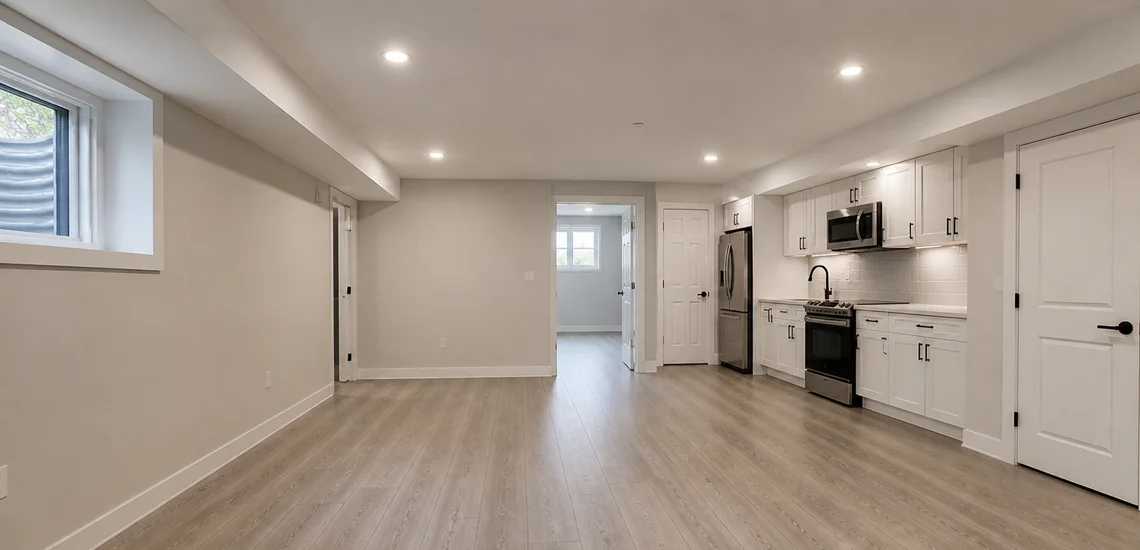
A legal basement apartment — also called a secondary suite or additional residential unit — is a self-contained living space with its own kitchen, bathroom, sleeping area, and entrance. To qualify, it must comply simultaneously with provincial building rules, fire safety regulations, and local zoning. Missing even one of these three layers makes the unit illegal, regardless of how nicely it’s finished.
The rules tightened in 2025. As of April 1, 2025, all new permit applications in Ontario must use the 2024 Ontario Building Code, which was harmonized with the National Construction Codes. If you’re working from old plans or relying on a contractor’s outdated checklist, you’re already behind.
Egress Windows: The Most Misunderstood Requirement
Egress windows are emergency exits — and they’re non-negotiable for any below-grade bedroom. The Ontario Building Code is specific about what counts:
- Unobstructed openable area of at least 0.35 m² (3.77 sq. ft.)
- No single dimension less than 380 mm (about 15 inches)
- The window must open from the inside without keys, tools, or special knowledge
- For below-grade windows opening into a window well, the well must provide at least 550 mm of clearance in front of the window
- If security bars are installed, they must have an interior quick-release mechanism
The clear opening is what counts — not the glass size, not the brochure dimensions. Inspectors measure the actual unobstructed space after the window is fully open. Casement windows are the practical favourite because nearly the entire frame opens; sliders and double-hungs need to be much larger to achieve the same compliant opening.
If your existing basement bedroom doesn’t have an egress window, you’ll need to cut the foundation, install a window well, and waterproof the assembly. This is structural work and is one of the more expensive parts of legalizing a suite.
Fire Separation Between Units
Fire separation is the single most common reason secondary suite inspections fail. The walls and ceiling separating the basement unit from the main dwelling must form a continuous fire barrier with a minimum fire-resistance rating — generally 45 minutes for newer homes, with reductions possible for older properties that have interconnected smoke alarms throughout.
What that translates to in practice:
- Drywall assemblies (typically two layers of 5/8″ Type X gypsum) on the ceiling and shared walls
- Solid-core, fire-rated doors at any opening between units, often with self-closing hardware
- Fire-stopping at all penetrations — plumbing, electrical, HVAC ducts
- Fire dampers where ducts cross rated assemblies
- Separate furnace return-air paths to prevent smoke migration between units
You’ll also need interconnected smoke alarms on every storey of the entire house — not just inside the suite — and carbon monoxide detectors near all sleeping areas if there are any fuel-burning appliances. The 2024 code now permits wireless interconnection, which can reduce installation costs significantly in retrofits.
ESA Electrical Inspections
Almost every basement apartment conversion involves new circuits, dedicated panels, or rewiring — and all of it must be approved by the Electrical Safety Authority (ESA). ESA is the independent body responsible for enforcing the Ontario Electrical Safety Code.
The process typically involves:
- Filing a notification of work with ESA — usually done by your licensed electrical contractor
- A rough-in inspection before drywall goes up, while wiring and outlet boxes are exposed
- A final inspection once fixtures, switches, and the panel directory are complete
- Issuance of an ESA Certificate of Acceptance
This certificate is what your municipal building inspector — and your insurance company, and any future buyer — will look for. Missing ESA documentation is one of the most common reasons real estate transactions involving secondary suites collapse at the closing table. Hiring a Licensed Electrical Contractor (LEC) is strongly recommended; they handle the paperwork and inspection scheduling, and their work is covered by ESA’s contractor warranty framework.
The Permit Process Step by Step
Legalizing an existing basement apartment usually follows this sequence:
- Zoning verification. Contact your municipality’s planning department to confirm secondary suites are permitted at your address and that your lot meets parking, lot coverage, and setback rules.
- Professional drawings. Hire a BCIN-certified designer to prepare floor plans, elevations, and a site plan that meet the Ontario Building Code.
- Building permit application. Submit drawings to the city. Approval typically takes 4 to 8 weeks for straightforward applications, longer if a minor variance is required.
- Construction. Work begins only after the permit is issued.
- Staged inspections. Framing, fire separation, plumbing, ESA electrical, HVAC, and final occupancy inspections happen at different stages.
- Registration. Some municipalities, including Toronto, require legal secondary suites to be registered after final approval.
Total project timelines run 4 to 7 months from start to finish for most retrofits.
Common Mistakes That Cause Inspection Failures
A few patterns come up repeatedly when projects fail. Make sure to avoid the following:
- Starting work without permits, then trying to retroactively legalize after drywall is up
- Installing slider or awning windows that don’t meet the clear opening requirement
- Skipping fire dampers in ducts that cross unit boundaries
- Wiring without ESA notification, then having to open finished walls
- Assuming an old grandfathered suite is automatically compliant — it almost never is
If you’re planning a comprehensive conversion and want a contractor experienced with secondary-suite compliance, specialists in Toronto basement renovation can manage the design, permits, and trades from start to finish.
Is It Worth the Cost?
Legalizing a basement suite in Ontario typically costs between $20,000 and $85,000, depending on how much structural and mechanical work is needed. Against that: legal suites in the GTA rent for $1,500 to $2,500 per month, your home insurance actually covers the rental activity, and the unit becomes a documented asset that adds resale value. An illegal suite, by contrast, is a liability that can trigger fines, denied claims, and forced demolition.
For homeowners weighing a more ambitious upgrade alongside legalization, our 2026 guide to luxury basement renovations covers high-ROI finishes that pair well with a compliant rental suite. You can also explore the basement finishing service overview for a sense of scope, or browse more basement renovation guides for project-specific advice.