Key Takeaways: Strategic Basement Reno
Safety Check: Always test for Radon and Moisture before closing up walls.
Legal Must-Have: You must install an egress window for any basement bedroom to meet Ontario building codes.
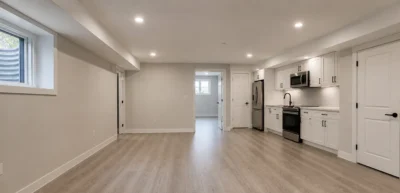
Best Materials: Use Luxury Vinyl Plank (LVP) and Mineral Wool insulation; they handle basement humidity better than wood or fiberglass.
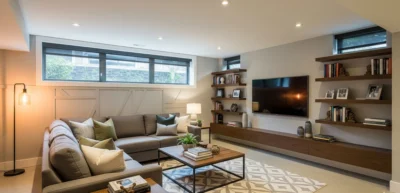
Lighting Trick: Use recessed LED pot lights and satin-finish paint to eliminate the “cave” feel and brighten the space.
Property Value: A professional, legal renovation can add up to 15% to your home’s total market value.
In the Canadian real estate market, your basement is more than just a storage space for hockey gear and holiday decorations—it is your home’s greatest untapped asset.
At Renovation Advisor, we’ve seen how a well-executed basement suite can increase a property’s value by up to 15%. However, a “finished” basement and a “legally renovated” basement are two very different things. Here is how to navigate the process like a pro.
1. The “Safety First” Check: Moisture and Radon
Before you pick out flooring or paint colors, you must address the two silent enemies of Canadian basements: water and gas.
-
The Moisture Test: Tape a 2-foot square of plastic sheeting to your concrete floor. If condensation forms under it after 48 hours, you have a moisture problem that needs a sub-floor or sealer before you lay down laminate.
-
Radon Testing: As homes are sealed tighter for energy efficiency, Radon gas can trap itself in basements. We recommend a long-term test kit before closing up your walls with drywall.
2. Navigating the “Legal” Basement: Permits and Egress
Google’s SpamBrain rewards content that provides “high-utility” information. In Ontario, if you plan to include a bedroom, you must have an egress window.
An egress window isn’t just a window; it’s a life-saving exit. It must be large enough for a firefighter in full gear to climb through.
-
Pro Tip: If you are digging a window well for egress, ensure it has proper drainage connected to your weeping tile to avoid turning your new bedroom into an aquarium during the spring thaw.
3. The “Comfort Factor”: Choosing the Right Materials
Basements are naturally colder and more humid than the rest of the house. To pass the test of time, you need materials that “breathe.”
-
Flooring: Steer clear of solid hardwood. Even with a subfloor, the expansion and contraction will cause buckling. Luxury Vinyl Plank (LVP) is the gold standard for basements—it is 100% waterproof and mimics the look of wood perfectly.
-
Insulation: Use Spray Foam or Mineral Wool (Roxul). Unlike fiberglass batt insulation, these materials don’t lose their R-value if they get damp, and they are naturally resistant to mold and fire.
4. Designing for Lighting (The “Anti-Cave” Strategy)
The biggest mistake in basement renovations is inadequate lighting. To make a basement feel like an integrated part of the home:
-
Layer your light: Use LED recessed “pot lights” for general brightness, but add wall sconces for warmth.
-
Paint choice: Use a “Satin” or “Eggshell” finish rather than Matte. The slight sheen helps bounce light around the room, making low ceilings feel higher.
The ROI: Why Basement Renovations Make Sense Now
With the rise of multi-generational living and the “work-from-home” revolution, a finished basement provides the highest Return on Investment (ROI) of almost any home project. Whether you are building a legal secondary suite for rental income or a high-end home cinema, the key is doing it right the first time.
Are you planning a basement transformation? Don’t guess on the costs or the codes. Visit our Basement Renovation Services page to get a professional consultation and ensure your project is built to last.